

If you've ever dug into the world of microscope objectives, you've probably run across the terms "195 tube length" and "185 tube length" thrown around like they're industry shorthand. As someone who's spent the last decade supplying high-quality microscope objectives, I get asked weekly: Can a 195 achromatic objective be used for high-magnification imaging? The short answer is yes-if you understand what "high magnification" actually means, how tube length impacts performance, and where 195 achromatics fit in the broader lineup of options like our [Infinite Plan Achromatic Objective Lens] and [Infinity Plan High Contrast Objective]. Let's break this down, no jargon overload, just real-world insights from someone who's fielded this question from biologists, materials scientists, and hobbyists alike.
First, let's settle the basics: what is a 195 achromatic objective, and how is it different from other designs? Tube length refers to the mechanical distance between the objective's mounting shoulder and the eyepiece's focal point, a specification that's been a standard for traditional finite-conjugate microscopes since the mid-20th century. A 195 achromatic is calibrated explicitly for a 195 mm tube length, unlike older 160 mm designs or the modern infinity-corrected systems that dominate labs today (wait, side note-our [Achromatic Microscope Objective] page clarifies that both finite and infinity-corrected achromatics share the same core design, just adjusted for tube length). Achromatic objectives, by nature, correct for two wavelengths of light (usually red and blue) to minimize chromatic aberration, and spherical aberration at the green wavelength-they're the workhorse of basic to intermediate microscopy, reliable and affordable for routine use.
Now, "high magnification" is the key term here, and it's not a one-size-fits-all number. Most people think 400x is "high" and 1000x is the upper limit for light microscopes. Let's ground that in numbers: total magnification is objective magnification times eyepiece magnification (usually 10x). So a 40x objective gives 400x total, a 100x gives 1000x. For 195 achromatics, the available magnifications typically range from 4x to 100x-so the 40x and 100x 195 achromatics are the ones most people associate with "high" for this line.
Here's where the common confusion comes in: people often assume infinity-corrected objectives are the only choice for high-magnification work, but that's not true for applications where performance is measured by utility, not edge-on contrast. A 100x 195 achromatic, for example, is a staple in high school biology labs and small clinical labs because it delivers enough magnification to see cell structures like mitotic spindles or bacteria-critical for routine high-mag tasks that don't require the extra correction of plan or apochromatic lenses. But let's address the limitations, because no lens is perfect. Chromatic aberration is more noticeable at higher magnifications, especially with 100x 195 achromatics; you might see a faint blue or red fringe around edges of objects, especially with brightfield illumination. Also, field curvature (blurriness at the edge of the field of view) is present, though less than in older non-plan achromatics. If you're working in a modern lab with an infinity-corrected setup, you can even adapt a 195 achromatic, but you'll need a tube lens to adjust for the finite tube length-something we cover in detail on our [195 Achromatic Objective] product page, since that's a common adjustment customers ask about.
Wait, let's compare that to similar lines to put this in perspective. Our [185 Achromatic Objective] line is calibrated for a shorter 185 mm tube length, so it's only compatible with specific older microscopes, whereas our 195 line is the standard for most legacy finite microscopes still in use today. Infinity-corrected lenses like the [Infinite Plan Achromatic Objective Lens] or [Infinity Plan High Contrast Objective] do offer sharper field of view and less aberration, but they're more expensive, and for routine high-mag tasks-like counting blood smears, observing protozoa in pond water, or checking histology slides at 400x-our 195 achromatics hold their own. I've had a cancer researcher come to me last year saying they'd been using a 195 40x achromatic for 5 years to look at cell cultures, and they only upgraded to an infinity plan when they started doing high-resolution fluorescence work; for brightfield, it was more than enough.
Another point: numerical aperture (NA) is non-negotiable for high-magnification imaging, because NA determines resolution (the smallest detail you can see). For a 100x 195 achromatic, typical NA is around 1.25 (dry) or 1.25 oil-immersion. That's the same NA as many entry-level infinity-corrected achromatics, so resolution is nearly identical for brightfield applications. The only tradeoff is the corrected field and chromatic performance, which isn't an issue if you're not publishing high-resolution images or doing specialized imaging. I once helped a small university lab swap out their old 160 mm objectives for our 195 line, and they found that their 400x and 1000x brightfield images were just as sharp for their student training purposes, at half the cost of new infinity-corrected lenses.
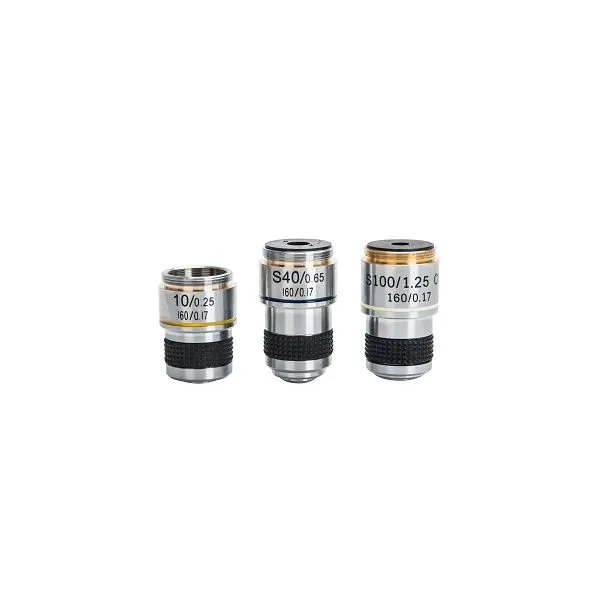

Let's talk about common pitfalls to avoid if you're using a 195 achromatic for high magnification. First, never use a 195 objective on a microscope calibrated for 185 mm tube length-you'll get spherical aberration that makes your images blurry, no matter the magnification. Second, if you're using oil immersion for the 100x objective, make sure you're using the right immersion oil (same refractive index as the lens, which we note in the product specs on our [195 Achromatic Objective] page) to avoid resolution loss. Third, don't push magnification beyond what the objective can support: if you pair a 100x 195 achromatic with a 20x eyepiece, you're making a 2000x total magnification, which is "empty magnification"-it looks bigger, but you're not seeing any more detail, because the NA of the lens can't support that. Stick to 10x eyepieces for these objectives to get the most out of their high-mag capability.
Is there a time when a 195 achromatic isn't good for high magnification? Absolutely. If you're doing super-resolution microscopy, quantitative fluorescence imaging where color accuracy matters, or looking for uniform sharpness across the entire field of view at 1000x, you'll want to step up to our plan achromatic or apochromatic lines like the [Infinite Plan Achromatic Objective Lens]. But for 90% of routine high-magnification applications-from K-12 lab work to small clinic diagnostics to hobbyist microscopy-a 195 achromatic is more than sufficient, and it's a great option if you're on a budget or working with a legacy finite microscope that can't take infinity-corrected objectives.
As someone who's built their business on supplying reliable, practical microscope accessories, I've seen too many people overcomplicate this question. They think they need the fanciest lens to get good high-mag images, but that's not true. Our 195 achromatic line is designed to deliver consistent, usable high magnification for the tasks that most microscopists actually do every day. We've worked with thousands of customers-from middle school science teachers to plant biologists studying pollen grains-who swear by our 195 40x and 100x objectives for their high-mag work.
If you're curious about integrating a 195 achromatic into your setup, or comparing it to other options like the [185 Achromatic Objective] or our infinity lines, our team can walk you through compatibility with your microscope, magnification needs, and any adjustments you might need (like tube length adapters for infinity-corrected bodies). Whether you're upgrading a legacy lab or setting up a new small-scale microscopy space, our range of achromatic objectives-including the [Achromatic Microscope Objective] line that covers all common tube lengths-has options tailored to your needs. For high-magnification work in particular, the 195 achromatic is workhorse that delivers solid performance without the premium price tag.
Ready to see what a 195 achromatic can do for your high-magnification imaging tasks? Our team is here to discuss your specific microscope setup, required magnifications, and any questions you have about our line of objectives. Reach out to connect for a procurement consultation that fits your needs and budget.
References
- Inoue, S., & Spring, K. R. (1997). Video Microscopy: The Fundamentals. Plenum Press.
- Abramowitz, M., & Davidson, M. W. (2020). Objective Lenses in Light Microscopy. Microscopy Primer, Olympus Life Science.
- Rustgi, S., et al. (2018). Basic Concepts in Light Microscopy for Cell Biology. Journal of Cell Science, 131(12), jcs217648.